Back to Blog
How Dealerships Book More Service Appointments Without Adding More Staff
Dealerships book more service appointments without adding staff by implementing an AI voice agent that handles inbound service calls automatically, accesses live DMS availability in real time, and books appointments directly into the service schedule, operating during peak hours when advisors are occupied and after hours when the dealership is closed.
The Appointment Booking Gap Most Dealerships Are Not Measuring
Service departments that track appointment fill rates often focus on the appointments that were booked, the vehicles that came through the lane, and the repair orders that were closed. What is harder to track, and therefore easier to overlook, is the demand that was never captured in the first place. A call that arrives at 8:45 AM when three advisors are each already with a customer at the counter, rings four times, and goes to voicemail does not appear in any report. There is no missed appointment in the DMS, no lost RO on the ledger, and no alert to the service manager. The customer who called may rebook later, may call a competitor, or may simply defer the service entirely. The dealership has no visibility into which of those outcomes occurred.
Industry research from CallRevu tracking inbound call handling across dealership service departments has found that a significant proportion of service calls either go unanswered or fail to result in a booked appointment. The problem is not that service advisors are performing poorly; it is that advisor capacity and inbound call volume do not align in real time, and the existing phone system has no intelligent fallback for when that mismatch occurs.
Why the Problem Is Structural, Not a Staffing Issue
Adding a service advisor or a BDC representative to handle overflow calls is a reasonable first instinct, but it addresses a symptom rather than the underlying mechanics. Inbound call volume in a service department does not distribute evenly across the day. It peaks at opening, again mid-morning, and often spikes immediately after hours when customers who could not call during the day finally have time to reach out. Staffing to that peak means carrying overhead during quieter periods. Staffing to the average means gaps at exactly the moments when the service lane has the most to gain.
The structural solution is a call-handling layer that operates continuously without adding fixed overhead. An AI voice agent deployed on inbound service calls provides coverage at every hour, scales to call volume automatically, and does not require scheduling, training adjustments, or management overhead beyond the initial configuration.
What Changes When Every Service Call Gets Answered
When every inbound service call receives a response, whether the service lane is at capacity, whether it is a Tuesday morning or a Sunday evening, the appointment booking dynamic shifts fundamentally. Customers who would have left a voicemail and possibly not followed up instead complete their booking in the same call. Customers who call after hours receive immediate assistance rather than encountering a voicemail box that will not be checked until morning. The service schedule fills based on actual customer demand rather than the subset of demand that happens to call during windows of staff availability.
For a dealership handling 400 inbound service calls per month, even a modest improvement in the rate at which those calls convert to booked appointments represents a meaningful increase in repair order volume. NADA data on average service RO values consistently places the average dealership service RO above $300 for customer-pay work. The arithmetic of recovering even a fraction of previously missed calls is not difficult to run.
How Viova Handles Inbound Service Calls
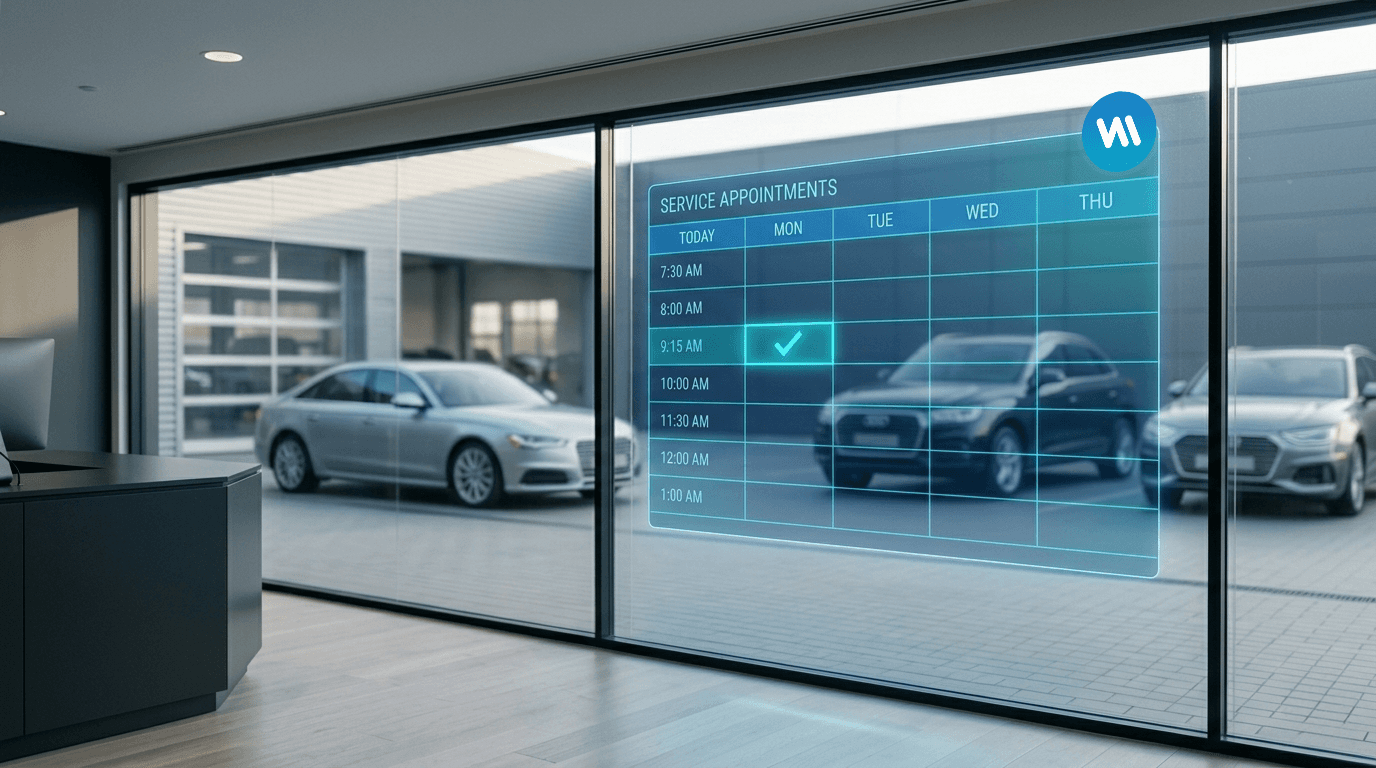
Viova answers inbound calls, identifies the caller's intent, and proceeds through the service booking workflow using live DMS data. When a customer calls to book an oil change, a tire rotation, or a recall repair, Viova accesses the dealership's real service availability in real time, walks the customer through available appointment times, confirms the booking, and writes the appointment directly to the DMS. The service advisor arrives at a fully populated schedule without having handled that call.
For calls that fall outside routine appointment booking (e.g. a customer with a complex warranty question, a repeat service concern that requires advisor context, or an inquiry that the dealership's configuration routes to a specific team member) Viova performs a warm transfer with the call context intact. The customer is not asked to repeat themselves, and the advisor receives the call with full information about what the customer needs.
Viova does not replace the service advisor's role in the service lane. It removes the call-handling volume that pulls advisors away from the customers already in front of them, and it captures the demand that arrives when advisors are occupied or the dealership is closed.
Fixed Ops Applications: Where the Appointment Recovery Happens
The highest-impact windows for AI voice agent deployment in fixed operations are the following:
Peak morning hours. The period between 7:30 AM and 10:00 AM in most service departments generates the highest concurrent call volume. Advisors are managing vehicle drop-offs, conducting walkarounds, and opening repair orders simultaneously. An AI voice agent handles the inbound calls that arrive during this window without requiring advisor attention.
After-hours and weekend calls. Customers who work during dealership hours frequently call in the evening or on weekends. Without an AI voice agent, these calls result in voicemails that may or may not be actioned before the customer's interest has moved elsewhere. With Viova, these calls result in booked appointments regardless of when they arrive.
Advisor absence and short staffing. Service departments with a single advisor absent, a training day in progress, or a temporary staffing gap face a compressed capacity window. An AI voice agent maintains consistent call coverage during these periods without requiring management to redistribute workload.
Frequently Asked Questions About Voice AI Agents for Dealerships
Does an AI voice agent book appointments directly into the DMS? Yes, when properly integrated. Viova writes appointment data directly to the dealership's DMS, including PBS Systems, in real time. The appointment appears in the service schedule without requiring any manual entry by staff.
What if a customer wants to speak with a human advisor? Viova performs a warm transfer to the appropriate team member when the customer requests it or when the call falls outside the AI's configured scope. The customer is not left without a path to a human contact.
How does the system handle high call volume simultaneously? An AI voice agent handles concurrent calls without degrading in quality or requiring queuing, which is a meaningful operational advantage during peak-hour spikes when a single phone line or a single advisor cannot handle multiple calls at once.
Will the AI voice agent work with the dealership's existing phone system? Viova is designed to integrate with existing dealership phone infrastructure. Implementation requirements depend on the current system configuration and are reviewed during the onboarding process.
How quickly can a dealership see results after implementation? Appointment capture improvements are typically visible within the first billing cycle as after-hours and peak-hour calls that previously resulted in voicemails begin converting to booked appointments.
The Operational Bottom Line
Service departments that rely entirely on advisor availability to handle inbound calls are, by structural necessity, capturing only a portion of their available service demand. The portion they are missing is not random; it concentrates in the most operationally challenging windows — peak hours, after hours, and periods of reduced staffing — which are also the windows when recovering that demand would have the most impact on appointment fill rate and repair order volume.
An AI voice agent purpose-built for dealership fixed operations addresses this gap directly. It handles the call volume that exceeds available capacity, converts it to booked appointments through live DMS integration, and returns the operational bandwidth to service advisors who are better deployed managing the customers already in front of them.
Dealerships ready to assess their current call capture rate and understand what a realistic recovery looks like for their service department can book a demo with Viova to walk through the numbers with the team.
Share Article
More Articles