
Back to Blog
What an AI Voice Agent Actually Does in a Dealership, and What It Does Not
A clear, practical breakdown of what an automotive AI voice agent does in a real dealership environment, how DMS-integrated call handling works, and what it does not replace.
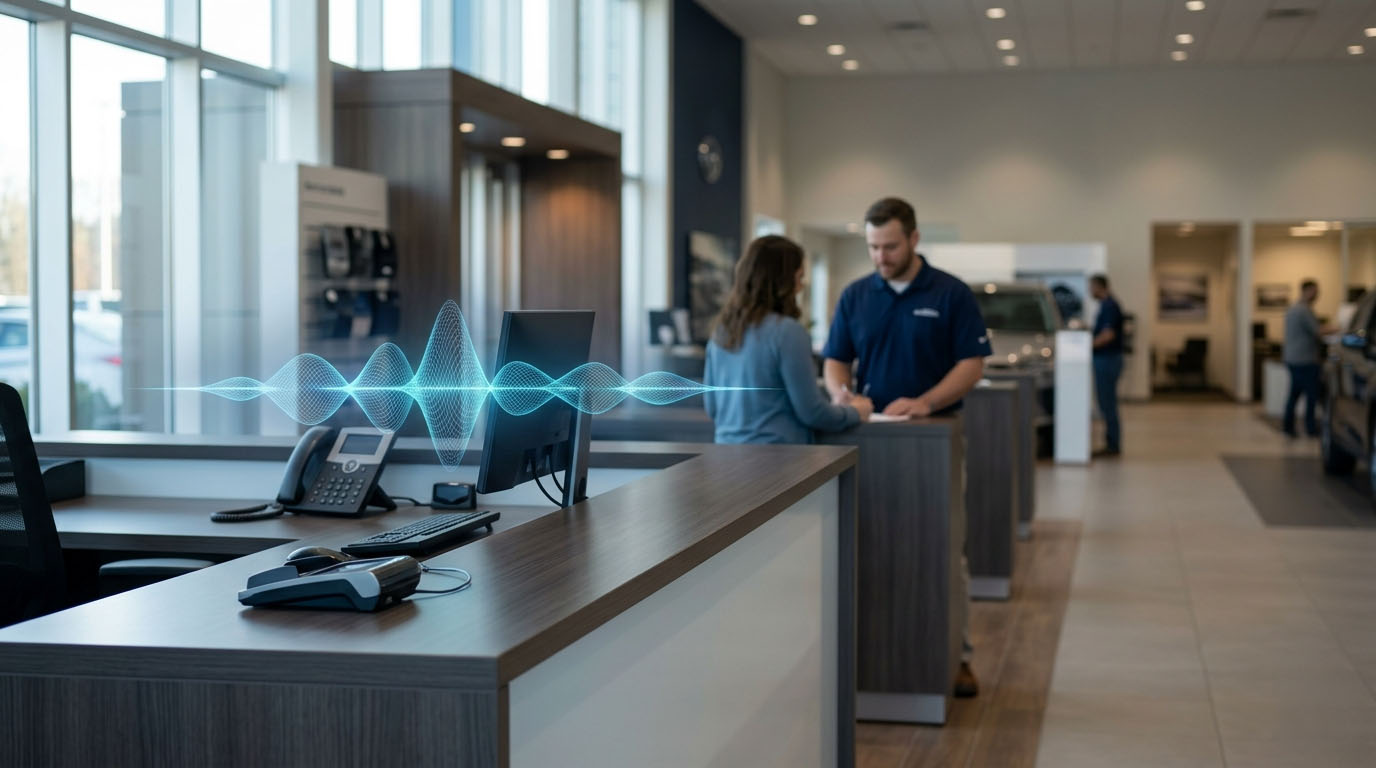
Picture a Tuesday morning in the service lane. Two advisors are writing up back-to-back customers. A third is on hold with a parts supplier. The phone rings at 8:47 AM, then again at 8:49. Neither call gets answered. By the time the desk clears enough for someone to check for messages, one caller has left a voicemail and the other has not. The voicemail gets returned three hours later. The second caller may or may not have moved on.
This is not a story about underperforming staff. It is a story about the structural reality of service lane operations, where inbound call volume and available headcount are rarely synchronized, and the phone system has no intelligent fallback when the gap opens up. It is also the most accurate context for understanding what an AI voice agent for dealerships is designed to address and, equally important, what it is not designed to address.
Why Call Volume Outpaces Capacity in Both Fixed Ops and Variable Ops
Service departments bear the largest share of dealership inbound call volume by a significant margin. Research from Marchex, a call analytics firm that analyzed more than 8 million inbound calls across U.S. dealerships, found that nearly 70 percent of all inbound dealership calls are inquiries for parts and service. That same study found that more than 19 percent of calls to dealerships were unanswered or abandoned before reaching the right person. The problem is not unique to any specific brand, size, or market. It appears at franchise dealers running high-volume service lanes and at single-point operators managing fixed ops with lean advisor teams alike.
On the variable ops side, the pattern is different but the consequence is similar. Inbound sales calls tend to concentrate outside business hours and during periods when the sales floor is already occupied with floor traffic. A customer calling at 7:15 PM about a trade-in or a new vehicle inquiry is not a low-priority caller; research consistently shows that phone shoppers have a higher purchase conversion rate than email or form-fill leads. When those calls go to voicemail, the conversion rate drops to near zero, because most callers do not leave voicemails and do not wait to be called back.
The gap exists not because dealerships are poorly managed, but because phone handling at the volume and consistency that inbound demand requires is a capacity problem, and capacity problems do not disappear by asking the existing team to move faster.
What an AI Voice Agent for Dealerships Actually Does
An automotive AI voice agent answers inbound calls on behalf of the dealership when the team is unavailable, whether that is because every advisor is occupied with a customer, because it is 8:30 PM, or because it is a Saturday and the BDC staffing is reduced. When a customer calls, the agent responds in natural language, identifies the nature of the call, and handles it according to the dealership's actual workflow rather than routing the caller into a generic phone tree.
For service calls, that handling means the agent can answer questions about hours, service offerings, and vehicle status, and can book, reschedule, or cancel appointments directly into the dealership's DMS in real time. The appointment lands in the scheduling system automatically, with all required fields populated. When the service advisor opens their schedule the next morning, the appointments booked after hours are already there, no manual reconciliation required.
For sales and BDC workflows, an AI voice agent can capture inbound interest from callers with purchase or trade-in inquiries, schedule a callback at a time that works for the customer, and deliver that organized queue to the sales team rather than a list of missed calls to work through cold. This is a meaningful operational difference: a salesperson calling back a customer who requested a specific callback time is in a materially different position than one returning a missed call with no context and no appointment.
For calls that fall outside what the agent is equipped to handle, those involving complex complaints, escalating situations, or requests that require judgment from a specific team member, the agent routes the inquiry to the appropriate department via notification, so the right person follows up with full context.
What It Does Not Do
This is where clarity matters most, because there is a meaningful amount of marketing language in the automotive AI category that creates unrealistic expectations in both directions. Some overpromises lead dealership operators to expect capabilities the tools do not have. Some overcaution leads service managers and BDC directors to assume that deploying an AI voice agent means replacing the people who handle inbound calls today.
A purpose-built AI voice agent for dealerships does not replace service advisors. The advisors who build repair orders, assess customer concerns in the write-up lane, and maintain the kind of relationship with repeat customers that drives retention are not doing work that a voice agent replicates. What the agent handles is the inbound call volume that currently goes unanswered, not the interactions that advisors are already having. The advisors' job does not change; the difference is that fewer opportunities fall through the gaps while they are doing it.
An AI voice agent is also not an outbound marketing tool, a call recording system, or a CRM replacement. It does not initiate calls, and it does not produce operational analytics on its own beyond what is captured in the appointment and routing data. Dealerships that deploy one as part of a broader technology strategy will get cleaner inbound coverage; they will not get a new CRM or a call coaching platform.
How Purpose-Built Differs From Adapted
The automotive AI market includes tools built specifically for dealership workflows and tools adapted from general-purpose AI platforms with a dealership label applied. The distinction matters operationally in ways that are not always visible in a demo. A general-purpose voice AI may handle inbound calls competently at a surface level but fail on the details that define a real service interaction: the difference between booking a recall repair and booking a routine oil change, the handling of a customer who calls to ask whether a loaner vehicle is available, or the correct routing of a call that comes in for a specific advisor by name.
A purpose-built AI voice agent is trained on the language and logic of automotive retail. It understands fixed ops workflows and variable ops workflows as distinct operational environments, because the people who built it came from those environments. That operational specificity is what makes the difference between a tool that captures inbound demand reliably and one that handles simple calls adequately while failing on the ones that actually required judgment.
The Practical Outcome for Dealerships
When every inbound call is handled, including those that arrive at 6 AM before the service desk opens, during the Monday morning peak when three advisors are each with a customer, and at 9 PM when the BDC team has gone home, the dealership stops losing appointment opportunities to timing gaps it had no way to address with headcount alone. The team does not change how they work. The service advisor's morning schedule reflects the appointments booked overnight. The sales team's callback queue is organized, timed, and ready to work. And the calls that needed a person went to a person, with context.
That is what an AI voice agent for dealerships is built to do. The value is in the coverage it provides where the team cannot reach, not in the tasks it takes away from people who are already doing them well.
Book a Demo at viova.ai/book-a-demo to see how Viova handles inbound calls in a real dealership workflow.
Share Article
More Articles